
Suspension Wear: What Those Clunks, Bounces and Body Roll Mean
The bounce test for worn shocks
Push down hard on each corner of the parked car and let go. It should come up and settle. If it bounces more than once, the shock absorber has given up controlling that spring. A worn shock can't damp the movement, so the car floats and the tyre spends time off the road instead of planted on it. That's how a worn shock increases your braking distance, because the tyre bounces over the bump instead of tracking the road surface, and in the wet that's grip you don't have. A car that floats over the crests on the Calder is a car that's not planted in the wet, and that's the bit that catches people out.
Clunks, knocks and rattles over bumps
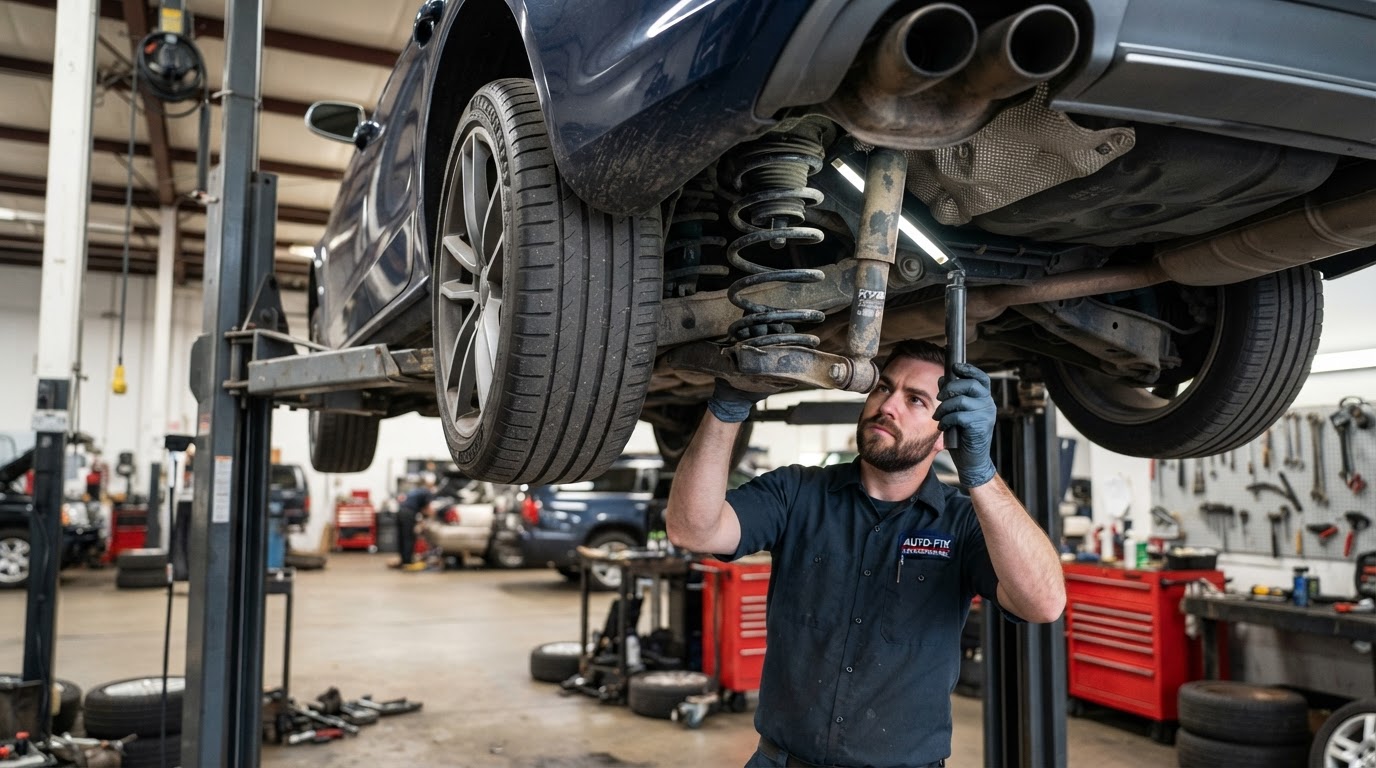
A clunk over a bump or when turning into a driveway is usually a worn suspension bush, a loose sway bar link, or a tired strut top mount. The rubber bush wears and lets the metal move, which is the knock you hear. Left alone, the play wears the mating surface and the part that was a bush becomes a control arm or a strut. We get the car in the air and lever each joint to find the one with play, then replace just that part. Sometimes it's a twenty-dollar link, sometimes it's a bush pressed into the arm. We tell you which before we order it, so you know what you're paying for before the parts land.
Body roll and nose-dive
If the car leans hard in corners or the front dives under braking, the shocks or the springs are tired. New dampers hold the body level through the weight transfer, which keeps the braking distance down and the rear tyres doing their share. A car that nose-dives is putting all the weight on the front axle, and the rear brakes can't help because there's no load on them. It also pitches the geometry of the front suspension out, which changes your camber and your tyre wear mid-corner, so the suspension wear feeds straight into the tyre wear, which feeds straight into the next bill.
How suspension wear ruins tyres
Worn bushes or a knocked-out alignment let the wheel angle change under load, scrubbing the tread unevenly. You'll see it as cupping, where the tread blocks wear in a scalloped pattern, or feathering across the face. If your tyres are wearing unevenly, the suspension and the alignment both need checking, because they feed each other. Fit a new set of tyres onto worn bushes and you'll ruin them in a few thousand kilometres. We replace the bushes, set the alignment, and the rubber wears flat, which is the point of fitting good rubber in the first place.
The tradeoff on replacing parts in pairs
Shocks and bushes get replaced in pairs on the same axle, because if one side's worn, the other's close. A new shock on one side and a tired one on the other gives you uneven handling and uneven braking, which is how a car pulls under brakes and how a wet roundabout catches you out. It costs more up front, but a pair of shocks is still cheaper than a set of tyres ruined by one good corner and one bad one. We'll tell you what needs doing and what can wait, so you're not replacing parts that have life in them, and you're not leaving a worn part to take out the one next to it.
What a road test tells you before the hoist does
Half the suspension diagnosis is done on a road test before the car goes up. A clunk that only happens on a left-hand turn over a bump, a float that only shows up at ninety, a dive that's worse under heavy braking, these are the symptoms that tell us where to look. We drive it first, then we put it in the air and find the play, because the road tells you what the hoist can't. A car that drives right but fails a hoist check is different to a car that drives wrong but looks right, and we sort which is which before we quote you for parts.
Key Takeaway
Get the knocks and the float sorted before they cost you tyres. Book a suspension check at PRD Automotive and Ben will put it in the air, find the play, and tell you straight what needs doing and what doesn't. Ring 03 9193 6500. Uneven wear usually points to the alignment too.
Have a Question About Your Car?
Ben is happy to talk through any part of your car's servicing or repair. Honest, upfront quotes before any work starts, and Afterpay & Zip Pay available in store.
Keep Reading
Logbook Servicing Explained: Protect Your New Car Warranty
You don't have to go back to the dealer for every service. A licensed independent mechanic can keep your new car warranty fully intact.
Brake Safety: 7 Signs You Can't Afford to Ignore
A squeal at the lights, a grind first thing, a pedal that sinks. Your brakes talk before they fail. Here's what each sound means.
Tyre Maintenance Guide: Safety, Wear, and Getting More Kilometres
Your tyres are the only thing between the car and the road. Get pressures, rotation and alignment right and they last thousands of km longer.