How to Tell If Your Car Needs a Wheel Alignment
The steering pulls one way
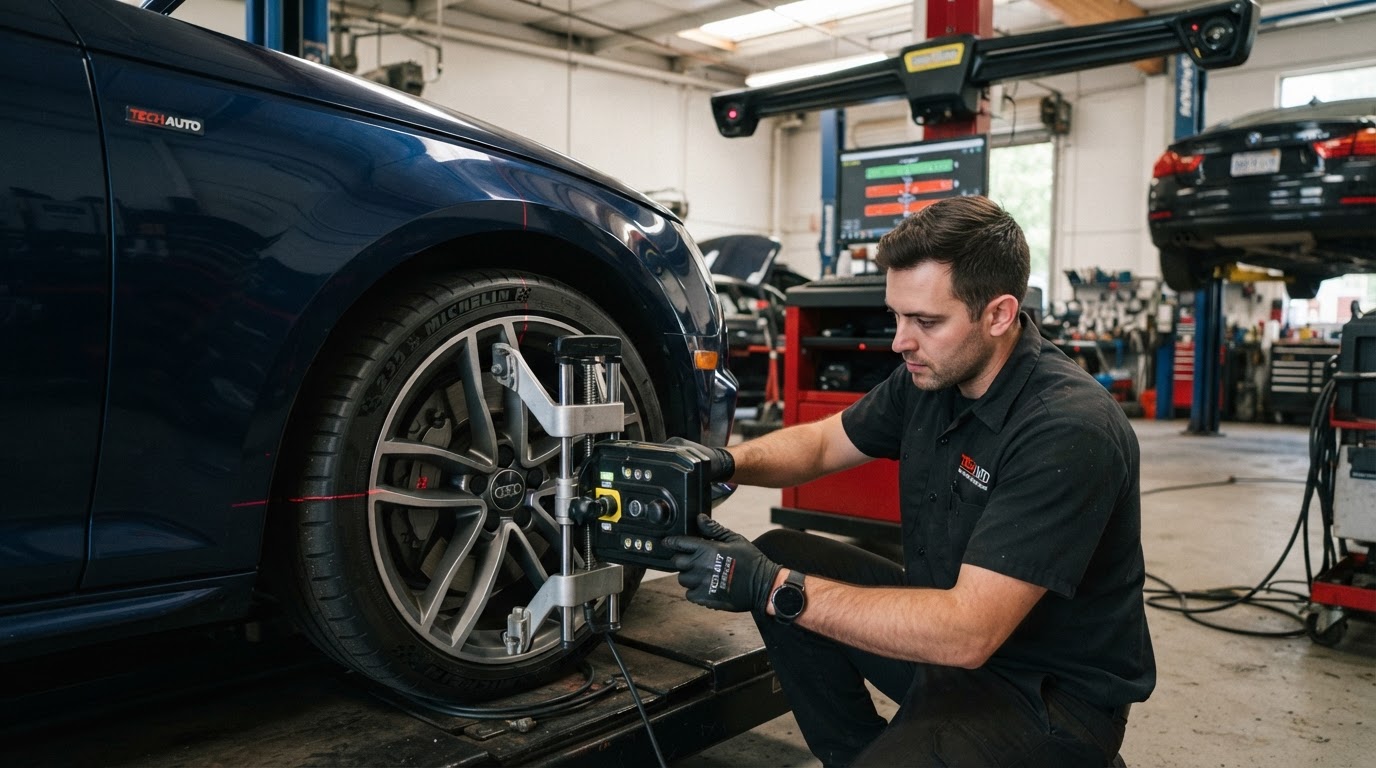
On a flat, straight road, with the wheel held light, the car should track straight. If it drifts left or right, the alignment's out. It can be the toe, the camber, or the caster, and each one wears the tyre differently. Toe-out scrubs the inner edge, toe-in scrubs the outer, and excess camber wears one side of the tread face. A pull can also be a dragging brake caliper or uneven tyre pressure, so we check the pressures and the brakes first, then set the alignment, so the pull goes and the wear stops. Guessing alignment before checking the basics is how you pay for an alignment and still have the pull.
The wheel sits off-centre
If you're driving straight and the steering wheel's crooked, the toe's out on one side, usually after a kerb or pothole knocked it. It's uncomfortable, it means the steering's centred to a misaligned angle, and it puts the airbag clock spring off its neutral position, which matters in a collision because the wheel's not where the airbag expects it. We centre the wheel, set the toe equal across the axle, and the wheel sits straight again. It's a five-minute fix on the machine and it's worth doing the week you notice it, not the month you fit new tyres and find out the old ones were ruined.
Feathered or uneven tread wear
Run your hand across the tread, lightly, one way then the other. If it feels smooth one way and rough the other, like the teeth of a saw, the toe's out and it's scrubbing the tread blocks sideways as the wheel rolls. If one side of the face is more worn than the other, the camber's the cause. Either way, the rubber that's worn off is gone for good, and the tyre won't last its rated life. An alignment stops it getting worse, but it can't put the rubber back, which is why catching it early matters. Read our tyre guide on checking tread before it's too late.
After a hit, or after new rubber
Any hard hit, a pothole, a kerb, a deep roadworks lip, can knock the alignment out in one go. You might not feel it for a few hundred kilometres, but the tyre will tell you in the wear. We do an alignment after any significant impact, and every time we fit a new set of tyres, so the rubber wears flat from the first kilometre. Fitting new KENDA tyres onto a misaligned car is a quick way to wear out the new set in a few thousand k's, which is money straight off the tread and into the bin. Alignment after new rubber is the cheapest way to make a set last.
How often to get it done
Every 10,000km, or at least once a year, is the rule we give. More often if you drive roads that are rough, or if you load a ute for work, because load changes the ride height and the geometry with it. A loaded van wears the alignment differently to an empty one, and a car that's been lowered or raised on different springs needs the alignment set to the new ride height, because the factory spec assumes the factory height. We set it to the factory spec for your car, not a generic setting, because the spec varies by model and by suspension option, and a generic setting is the wrong one.
The rear alignment people forget
Most people think alignment is a front-end job, but the rear has toe and camber too, and a rear alignment that's out wears the rear tyres just as fast. We adjust front toe and camber and the rear where it's adjustable, and centre the steering wheel so it sits straight at highway speed. Not every car has rear adjustment, but we check both ends and set what's there, because a front alignment on a car with a rear alignment that's out is half a job, and the rear tyres will still wear crooked.
Key Takeaway
If the steering's wandering or the tyres are wearing on one edge, get a precision wheel alignment at PRD Automotive before the rubber's gone. Call Ben on 03 9193 6500. Catching the wear early is in our tyre maintenance guide too.
Have a Question About Your Car?
Ben is happy to talk through any part of your car's servicing or repair. Honest, upfront quotes before any work starts, and Afterpay & Zip Pay available in store.
Keep Reading
Logbook Servicing Explained: Protect Your New Car Warranty
You don't have to go back to the dealer for every service. A licensed independent mechanic can keep your new car warranty fully intact.
Brake Safety: 7 Signs You Can't Afford to Ignore
A squeal at the lights, a grind first thing, a pedal that sinks. Your brakes talk before they fail. Here's what each sound means.
Tyre Maintenance Guide: Safety, Wear, and Getting More Kilometres
Your tyres are the only thing between the car and the road. Get pressures, rotation and alignment right and they last thousands of km longer.